
Fixed-Rate Payouts vs Shared Luck: Which Fee Suits You
One petahash per second produces 0.00047353 BTC a day at difficulty 132.76 T, which is $40.39 at a BTC price of $85,294. The gap between the listed 4% PPS+ rate on the PPS-settled block reward and the listed 2% PPLNS rate on both components together is about $24.23 a month at that size. The money is real but modest; the promise each mode makes about how steady your income feels is not.

Key takeaways
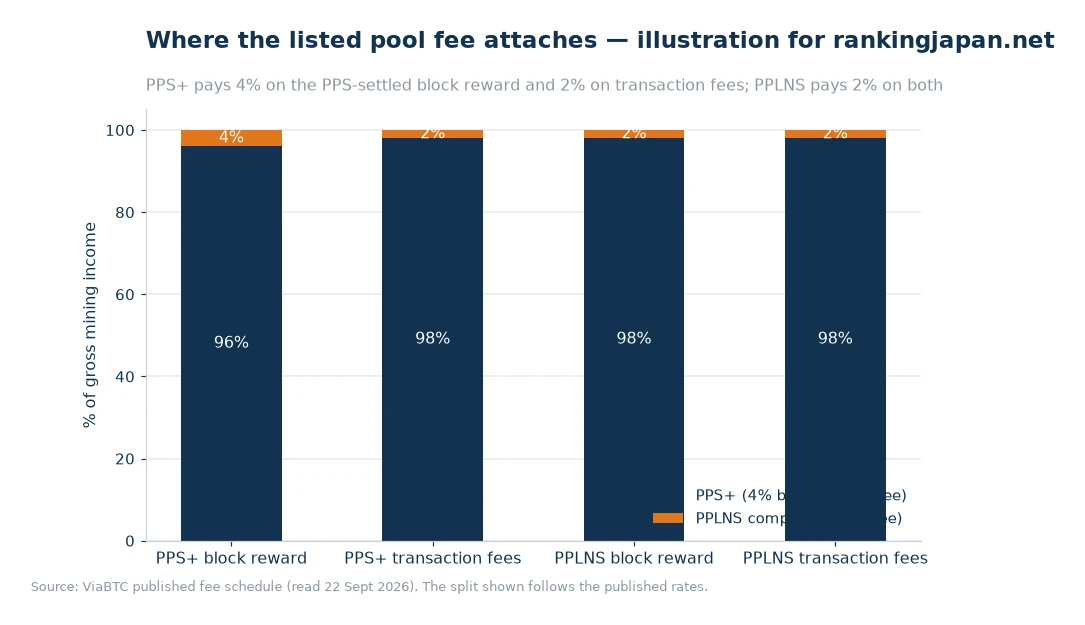
- PPS+ settles every hour at current difficulty, with a listed 4% on the PPS-settled block reward and a listed 2% on transaction fees.
- PPLNS charges a listed 2% on the block reward and transaction fees together, distributed over the last 5 difficulty rounds after 6 confirmations.
- At 1 PH/s the difference between the two listed rates is about $24.23 over 30 days; at 300 TH/s it is roughly $7.27.
- Neither mode moves the ceiling: your share of a 950.3 EH/s network still sets gross output at $0.0404 per TH/s per day.
What fixed rate and shared luck actually mean
PPS+ turns hashrate into a known credit per hour against the difficulty in force at the time, and the pool carries the risk that the next block takes longer than average to arrive. That certainty is what the higher listed rate buys: 4% on the block-reward component, which is the part of income that is fixed at 3.125 BTC per block and therefore the part the pool can promise against.
PPLNS inverts the arrangement. Your share is measured over the pool's last 5 difficulty rounds once the block has 6 confirmations, so income arrives in clusters that follow block discovery rather than the clock. A dry spell and a burst of blocks produce the same total over a long enough window, but they produce very different months, and the lower listed rate of 2% on both components is what you are paid for accepting that.
What the rate difference is worth
Compare the two modes on the component they have in common. At 1 PH/s the block-reward share is $40.39 a day, so 4% is about $1.62 a day and 2% is about $0.81 — a gap of roughly $0.81 a day, or about $24.23 across 30 days. At 300 TH/s the same two percentage points are worth about $7.27 a month, because the underlying output is smaller.
Two properties of that gap are worth holding on to. It is a fixed fraction of output, so it does not shrink when the pool has a slow week or grow when it has a fast one, and it is charged before your power bill is settled, so at low efficiency the fee and the electricity compete for the same margin. On 20 J/TH hardware the breakeven electricity price after the listed 4% fee is $0.0808 per kWh, and every cent above that comes out of the same pool of money the two percentage points came from.
In expectation the two modes converge over a long enough run, because the pool's blocks arrive at a rate set by its share of a 950.3 EH/s network whoever is being paid and whenever the credit lands. What differs is timing. PPLNS settles against the last 5 difficulty rounds once 6 confirmations are reached, so one generous window can lift an entire settlement, while a quiet window defers income instead of cancelling it.
| Point of comparison | PPS+ | PPLNS |
|---|---|---|
| Listed rate | 4% on the PPS-settled block reward, 2% on transaction fees | 2% on the block reward and transaction fees together |
| Settlement timing | Every hour, at current difficulty | After 6 confirmations, over the last 5 difficulty rounds |
| Who carries pool luck | The pool | The miner |
| Value at 1 PH/s, 30 days | About $38.77 a day net, near $1,163 over the month | About $39.58 a day net, near $1,187 over the month |
| Income shape | 24 small credits a day, roughly $1.68 each at 1 PH/s | Credits that follow block discovery and can bunch together |
The last row is where most operators misjudge the choice. The two daily net figures differ by less than a dollar, but the shape of the month is completely different, and how you finance electricity is a question about shape rather than about totals.
Worked example
Take 1 PH/s running continuously for 30 days. Gross output is 0.00047353 BTC a day, or $40.39 at $85,294. Under PPS+ the listed fee is 4% of the block-reward component: 0.04 x $40.39 = $1.62 a day, which leaves $38.77 net. Under PPLNS the listed fee is 2% of both components together: 0.02 x $40.39 = $0.81 a day, which leaves $39.58 net.
Across the month those nets work out to roughly $1,163 against $1,187 — a gap of about $24, or 2% of the gross figure, which is exactly the two percentage points of rate difference expressed in dollars. Now add one piece of operational reality: one hour of downtime at 1 PH/s costs about $1.68 of gross output whichever mode you chose. Sixteen hours of unplanned downtime would erase the entire fee advantage of the cheaper arrangement, which is why uptime discipline beats fee shopping at small scale.
Choosing by the shape of your operation
Start with the shape of your costs. If electricity is billed monthly at a fixed tariff and your fleet runs around the clock, hourly settlement lines up with how you pay for power, and the ViaBTC Pool Fees page is the place to confirm which component each rate lands on before you commit. If you can absorb a quiet fortnight without changing anything, the lower listed rate of PPLNS is a fair trade for variance you can already carry.
Then watch the two numbers that decide whether the arrangement is working: your settled output per day against the pool's share of network hashrate, which you can read as pool hashrate and luck on the pool state page, and your own hashrate history alongside the whole network on the Statistics view. If your credited output drifts from what your hashrate should earn, the discrepancy is usually uptime, not the fee line.
Whatever you pick, check it after one full settlement cycle. Compare the net credited with the output your hashrate should have produced at the difficulty in force — 1 PH/s at $40.39 a day gross is $38.77 under the listed PPS+ rate and $39.58 under the listed PPLNS rate — and if the credited figure sits below that range, look for missing hours before blaming the fee. The fee is a known fraction of output; uptime is the variable you actually control.
Frequently asked questions
Does PPS+ remove all income variability?
It removes pool luck from the block-reward component by paying hourly at current difficulty, but difficulty itself changes, and the transaction-fee component still varies block by block.
How long does a PPLNS payout wait?
Until the block reaches 6 confirmations, with the share calculated over the last 5 difficulty rounds of pool hashrate rather than over a fixed clock window.
Which mode earns more over a year?
The long-run average is close, and the difference between the listed rates is what separates them: about $24.23 over 30 days at 1 PH/s, or roughly $7.27 at 300 TH/s. Consistency of uptime moves the total far more than the mode does.
Decide on the month you can actually run
Write down gross output at your hashrate, subtract the listed rate you are choosing, and compare the result with your power bill before anything else. Then ask whether a month with fewer, larger credits would break your cash flow, because that is the real content of the choice. Re-run the arithmetic after each difficulty adjustment — a 1.90% increase trims income per terahash by about 1.86% — and treat uptime as the variable you control most directly.
Data and sources: the ViaBTC fee schedule[1] and pool state page[2]. Network difficulty 132.76 T, network hashrate 950.3 EH/s and BTC at $85,294, read 22 Sept 2026. All calculations here follow from the inputs above and will move as difficulty and price change; no earnings are promised.