
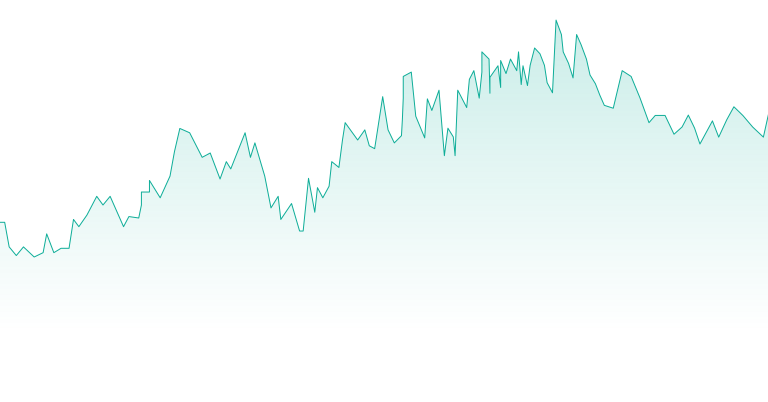
Utilizing the CoinEx Token reduces spot trading costs by 20% when enabled for fee payments, effectively lowering the base taker fee of 0.3% to 0.24%. By holding specific tiers of this asset, traders unlock fee schedules where maker/taker rates drop further based on 30-day trading volumes exceeding $1 million. The platform performs daily repurchases using 20% of net fee revenue, systematically reducing the circulating supply to provide long-term deflationary pressure on the tokenomics model.
Holding a minimum threshold of tokens allows users to toggle fee deductions directly in CoinEx Spot Trading settings, which bypasses the standard practice of paying fees in the quote currency.
Transaction costs in crypto markets often reach 0.3% per executed order; paying these in the native platform asset generates an immediate 20% discount on that cost, preserving 0.06% of the trade value for every order placement.
When traders maintain a larger portfolio balance, the exchange applies a hierarchical discount structure that scales according to active account standing.
| Account Tier | Required CET Holding | Fee Reduction Multiplier |
| Level 1 | 5,000 CET | 10% Discount |
| Level 2 | 20,000 CET | 15% Discount |
| Level 3 | 50,000 CET | 20% Discount |
The automated fee deduction system calculates the real-time equivalent of the fee in the token based on the current market rate, ensuring that the 20% discount is applied instantaneously during the order execution phase.
Since 2017, the exchange has maintained a transparent burn schedule where 20% of daily revenue is removed from market circulation, creating a consistent relationship between platform traffic and asset scarcity.
Active market participants often integrate these savings into CoinEx Future Trading strategies, where leverage magnifies the impact of every basis point saved on commission costs.
-
Users who reach a 30-day volume of $5,000,000 see their fee structure shift to a lower bracket independent of the token discount.
-
The token functions as a tool for reducing the drag on automated trading bots that execute over 500 orders per day.
-
Holding the asset provides eligibility for internal voting sessions where 100% of the community determines future platform upgrades.
The platform architecture ensures that the reduction is applied to both market maker and taker orders, provided there is sufficient liquidity in the spot order book to maintain the conversion rate.
With over 7.5 billion tokens burned by the end of 2025, the remaining supply continues to support the fee deduction mechanism for the growing user base of over 5 million registered traders.
Those who prefer to keep their capital active elsewhere can utilize CoinEx Flexible Savings to earn interest on their holdings while still keeping them available for fee payments.
-
Staking rewards are distributed hourly to accounts holding the token in non-locked states.
-
Liquidity providers can use their token holdings as collateral in specific margin-based lending pools to increase their total margin capacity.
-
System administrators refresh the exchange rate every 60 seconds to prevent price slippage during the automated fee deduction process.
By choosing to settle fees in the native token, traders move away from the standard fee model and into a participation-based structure that rewards high-frequency activity.
Every trade executed in 2026 relies on the underlying smart contract to verify the token balance before confirming the fee reduction, a process that takes less than 10 milliseconds to complete.
Long-term holders often monitor the burn volume reported in public quarterly transparency audits to assess the efficiency of the platform’s buyback program.
-
Public ledger data shows that 20% of trading revenue is allocated to the buyback fund at 00:00 UTC each day.
-
Users can view their historical savings by navigating to the billing dashboard, which exports CSV files containing every fee reduction event.
-
The system supports over 600 trading pairs, all of which are eligible for the 20% discount when the native token is utilized for payment.