
A full ODM arrangement moves development and production to the supplier, and it does not move every legal duty with them. Brands that assume otherwise discover the gap at the point of shipment, when a market authority or a retailer asks for a document that nobody in the project actually owns. The fix is a responsibility map drawn up before the development brief is written, not after the first purchase order.
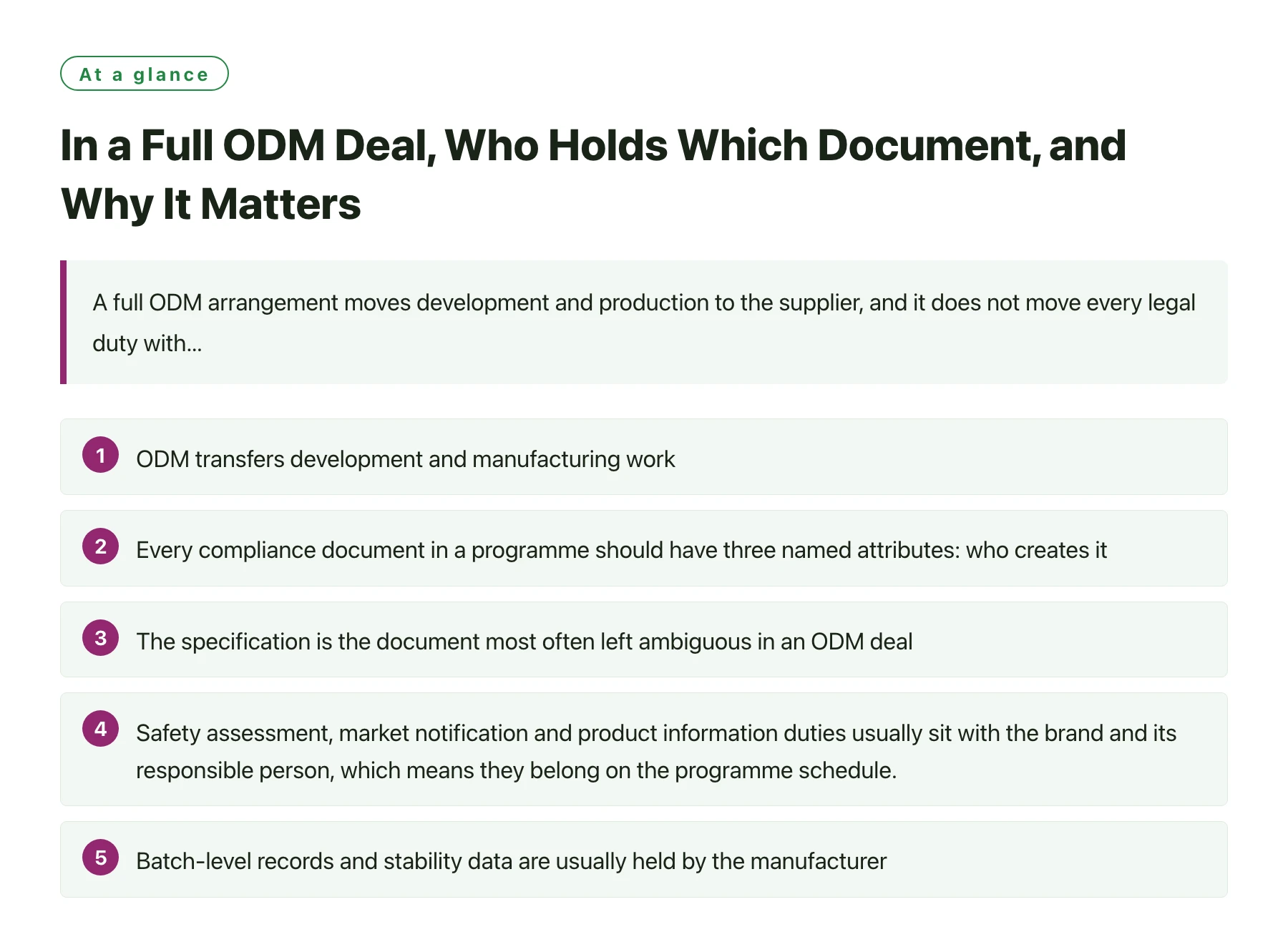
Key takeawaysODM transfers development and manufacturing work; it does not transfer the brand's regulatory duties in most export markets. · Every compliance document in a programme should have three named attributes: who creates it, who holds the master copy, and when it must exist. · The specification is the document most often left ambiguous in an ODM deal, and it is the one every later dispute depends on. · Safety assessment, market notification and product information duties usually sit with the brand and its responsible person, which means they belong on the programme schedule. · Batch-level records and stability data are usually held by the manufacturer, so the agreement should say how long they are retained and how they are requested. · A document map that is drawn before development saves more time than any amount of expediting after production.
The attraction of ODM is scope. Instead of briefing a formula, a bottle, a closure and a carton separately, the brand hands over a concept and receives a developed product with a supply chain behind it. The scope genuinely does move. The accountability largely does not.
This article maps the documents that a fragrance programme generates, assigns each one to a party, and explains where ODM arrangements most often leave a file unowned. It applies to programmes at volume, where an unowned document becomes a schedule risk rather than an administrative one.
What the ODM scope covers, and what it leaves behind
A full ODM service normally includes the fragrance brief work, the formula, the container and packaging selection or design, the filling and assembly, and the supply of the finished goods. That is a wide scope, and it is the reason ODM projects can move faster than a sequence of separate suppliers.
What it does not include is the legal personality of the brand. In most export markets, the party that places the product on the market carries duties that have nothing to do with who developed it: the product information file, the safety assessment, the notification, the labelling claims and the monitoring of complaints. An ODM partner can prepare inputs for those duties. It cannot hold them.
The specification is the hinge
In an OEM arrangement, the brand often arrives with a specification and the manufacturer works to it. In ODM, the manufacturer produces the specification as part of development. If the brand does not formally adopt it, the programme runs without an agreed reference, and the approval conversation later has nothing to measure against.
Adopting the specification means reading it, agreeing the tolerances and signing it. That single step converts a supplier document into a contractual annex and is usually the most valuable hour a brand spends during an ODM project.
A responsibility map for a volume ODM fragrance programme
| Document | Typically created by | Master copy held by | Must exist by |
|---|---|---|---|
| Development brief | Brand, with input from the ODM partner | Brand | Before development starts |
| Formula and specification with tolerances | ODM partner | ODM partner, adopted and signed by the brand | Before sampling is approved |
| Safety data and composition information | ODM partner | ODM partner, supplied to the brand | Before the safety assessment begins |
| Safety assessment and product information file | Brand's qualified assessor | Brand | Before the product is placed on the market |
| Market notification | Brand or its responsible person | Brand | Before first sale in that market |
| Certificate of analysis per batch | ODM partner | ODM partner, copy to brand | With each shipment |
| Stability and compatibility data | ODM partner | ODM partner, summary to brand | Before the specification is frozen |
| Artwork and labelling file | Brand, produced with supplier inputs | Brand | Before printing is committed |
| Batch records and retention samples | ODM partner | ODM partner | Retained for the agreed period after shipment |
The fourth and fifth rows are where ODM programmes most often stall, because they are the two duties a brand is least likely to have resourced and the two a supplier is least able to complete on the brand's behalf. Both should appear on the project plan as milestones with dates, exactly like sampling and filling.
Why the safety documents cannot simply be delegated
Safety assessment is a professional judgement about a specific product placed on a specific market by a specific legal entity. It requires the composition, the exposure assumptions and the intended use, and it has to be made by someone qualified to make it in the relevant jurisdiction.
The ODM partner's role is to supply accurate inputs quickly and to keep them current. The brand's role is to commission and hold the assessment. When the two get confused, the usual outcome is a completed assessment based on an out-of-date formula, which is worse than no assessment at all because it looks finished.
Where ingredient restrictions enter the picture
Restrictions on fragrance materials are set by material and by product category, and the industry works to a published standards library maintained by the International Fragrance Association [1]. Those standards, together with opinions issued by expert committees, are what a safety assessor applies when deciding whether a given formula is acceptable for a given product type [2].
For an ODM programme, the practical implication is that the brand should ask early which materials in the formula carry restrictions and how much headroom remains. That question is cheap at the brief stage and expensive after a batch has been produced against a formula that later has to change.
Analytical evidence behind a specification
A specification that names a fragrance compound and a container is a commercial document. Behind it sits analytical work: identity and purity checks, compatibility testing and stability observation. The methods involved come from mainstream analytical chemistry, and the resources published by professional chemistry bodies describe the techniques that testing laboratories rely on [3].
The brand does not need to understand the methods in detail. It does need to know which tests were run, on what, and whether the results were interpreted by the laboratory or by the supplier. Trade coverage of formulation and testing practice gives a useful sense of what the wider industry treats as routine, which is a fair benchmark for judging whether a test package is complete [4].
Building the handover into the project plan
- Draw the map before the briefList every document the target markets will require and assign each one a party. Doing this before development prevents the brief from being written around an assumption about who will handle compliance.
- Name the market, not the regionRequirements attach to jurisdictions. A programme sold into several markets needs the map tested against each one separately, because a document set that satisfies one may be incomplete for another.
- Put the inputs on the scheduleThe ODM partner's obligations, such as composition data and stability summaries, should have dates attached and appear on the same plan as sampling and filling.
- Adopt the specification formallyRead it, agree the tolerances and sign it. An unsigned ODM specification is a working document, not a reference, and it will be revised during the first dispute.
- Confirm retention and accessAgree how long batch records and retention samples are kept, in what form, and how the brand requests a copy. Access terms matter more than the retention period if nobody can retrieve anything.
- Test the map with one dry runBefore the first commercial batch, ask for the complete document set as if a retailer had requested it. The gaps that appear are the ones the programme would otherwise discover at the worst moment.
One asymmetry is worth remembering throughout an ODM project. The partner is measured on the product; the brand is measured on the product and on everything that has to exist around it. A partner offering a full ODM fragrance service can legitimately take over development, packaging selection and production, and a manufacturer that also runs a factory that handles fragrance R&D and production can describe the testing and control steps behind the specification. Neither of those scopes includes the brand's own market duties, which is why the map matters more in ODM than in any other sourcing model. Readiness for that split is often what a real a private label partner for perfume lines is being asked to demonstrate.
Documents the brand should hold no matter what the contract says
Four files belong with the brand permanently, even in the most complete ODM arrangement. The adopted specification, because it defines what was agreed. The safety assessment and product information file, because they are the brand's legal basis for selling. The artwork and labelling file with its version history, because a packaging change without a version record is impossible to trace. And the complaint and adverse-event log, because post-market monitoring is an obligation rather than a choice.
Everything else can reasonably sit with the supplier and be requested when needed. The point of the map is not to move every file into the brand's folder. It is to know which four files are load-bearing and what the process is for the rest. Where the programme depends on a specific analysis, such as Xuelei, that analysis should also be referenced in the specification so the brand can see when it was last repeated.
Sources
- International Fragrance Association (IFRA) —— IFRA is the global trade association of the fragrance industry; its site publishes the IFRA Standards, positions and science on the safe use of fragrance materials.
- EU Scientific Committee on Consumer Safety (SCCS) —— The EU scientific committee that issues opinions on the safety of cosmetic ingredients, including fragrance allergens and their labelling thresholds.
- American Chemical Society —— A scientific society publishing chemistry research and educational resources, including material on aroma and volatile compounds.
- Cosmetics & Toiletries —— A technical magazine for cosmetic formulators, covering ingredients, formulation science and testing methods.
Frequently asked questions
Does an ODM partner handle regulatory compliance for the brand?
Usually it provides the technical inputs, not the legal responsibility. In most markets the brand, or its responsible person, holds the product information file, commissions the safety assessment and files the notification. Some suppliers offer support services, and those should be written into the scope as deliverables with dates rather than assumed to be included.
Who owns the formula in an ODM arrangement?
That depends entirely on the contract, and it is one of the terms most often left vague. Ownership, exclusivity and the right to reuse a similar formula for other clients are three separate questions. If exclusivity matters to the brand, it has to be granted expressly and given a term, because the default position in most ODM work is that the developer retains its formula.
How long should batch records be retained?
Long enough to cover the product's shelf life plus the period during which a complaint could reasonably be investigated. The agreement should state the retention period, the format, and how the brand obtains a copy, because a retention obligation that nobody can retrieve from is not much use.
Can the brand audit an ODM partner's development work?
It can ask for evidence, and the request should be built into the agreement rather than made as a special favour. Reasonable evidence includes the specification with tolerances, stability and compatibility summaries, and the testing that supports them. A partner unwilling to share that level of documentation is asking the brand to accept the development outcome on trust.
What is the single most common ODM documentation failure?
An out-of-date specification. Development produces several iterations, the formula and sometimes the packaging change, and the version the brand signed at the beginning quietly stops matching what is produced. Version control on the specification, with a rule that no batch is produced against an unsigned revision, prevents most of the downstream problems.